
Multi-Tenant Signs in St. Charles County
A commercial property can have a great location, strong tenants, and steady traffic, yet still be difficult for customers to recognize from the road. This is especially common with shopping centers, office parks, medical developments, and mixed-use properties where several businesses share the same entrance or building.
That is where well-designed multi-tenant signs become valuable.
A multi-tenant sign does more than list the businesses located on a property. It can help drivers identify the development, give individual tenants greater visibility, guide visitors to the correct entrance, and create a more coordinated appearance for the entire property.
Throughout St. Charles County, including Wentzville, Lake St. Louis, O’Fallon, St. Peters, and St. Charles, the right solution can vary considerably from one property to another. A retail center positioned along a major roadway may benefit from a large illuminated pylon sign, while an office or medical development may be better served by an architectural monument sign and coordinated wayfinding system.
At Twin Clover Sign and Graphics, we approach signage as a custom project rather than simply placing names on a standard structure. We are a full-service sign shop, and our broader signage capabilities include indoor and outdoor signs, directional signage, storefront signs, custom business signs, and other solutions that can work together throughout a property. Twin Clover Sign and Graphics
What Is a Multi-Tenant Sign?
A multi-tenant sign is a sign designed to identify several businesses, organizations, or occupants located within the same commercial property.
You commonly see them outside:
- Shopping centers and retail plazas
- Office parks
- Medical and professional buildings
- Mixed-use developments
- Corporate centers
- Commercial and industrial properties
- Multi-building campuses
- Apartment and multi-unit developments
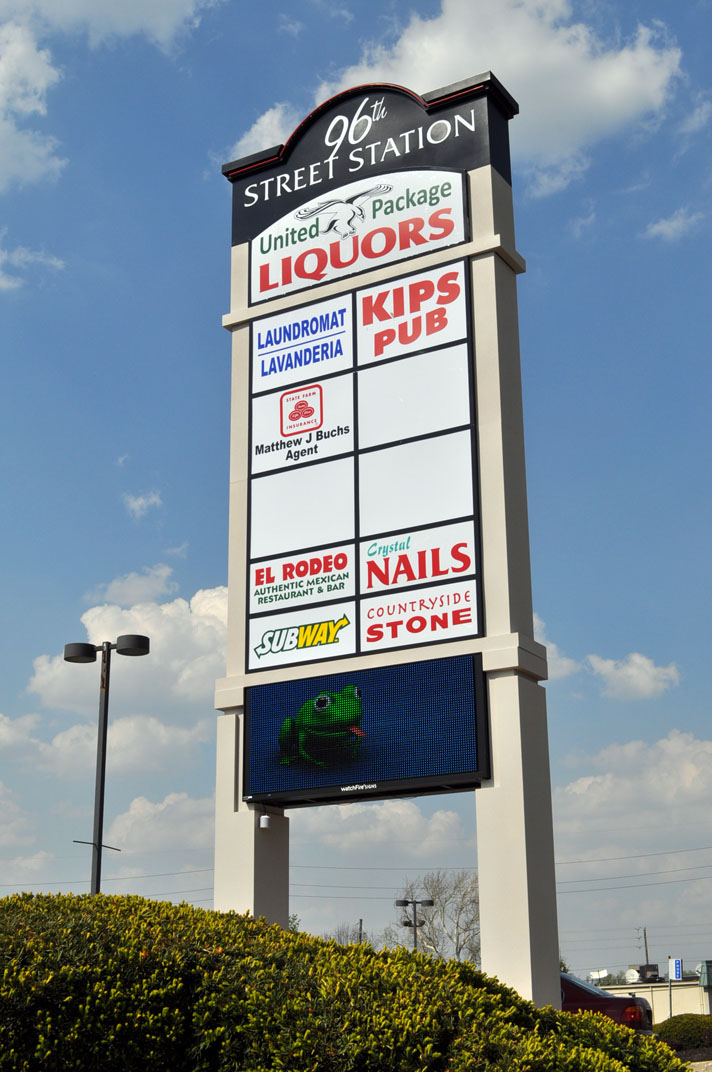
The sign will often include the name of the overall development along with individual tenant names or logos. Depending on the property, those tenant identities may be displayed on replaceable panels, illuminated cabinets, dimensional elements, or digital displays.
The primary roadside sign is also only one part of a complete signage system. A large shopping center, for example, may have a multi-tenant pylon sign near the street, individual storefront signs on each business, and directional signs within the parking lot.
Thinking about those pieces as one connected system generally produces a much better result than treating each sign independently.
Why Multi-Tenant Signage Matters
The most obvious purpose of a multi-tenant sign is visibility, but its value extends beyond simply being seen.
Better Visibility for Individual Tenants
Businesses located within a larger development can be difficult to notice from the road, especially when the building is set back behind a large parking lot.
A prominent multi-tenant sign gives those businesses an additional opportunity to be seen before a potential customer reaches the property.
The design needs to account for the fact that motorists may have only a short amount of time to read the sign. Giving every tenant a panel does not automatically make every tenant visible. Letter size, spacing, contrast, sign height, traffic speed, viewing distance, and the number of businesses being displayed all matter.
A thoughtfully designed sign prioritizes readability rather than simply fitting the maximum possible amount of information into the available space.
A Stronger Identity for the Entire Property
Multi-tenant signage can also establish the identity of the shopping center, office park, or commercial development itself.
Architectural materials, colors, dimensional elements, lighting, landscaping, and the overall shape of the sign can be coordinated with the surrounding property. This makes the sign feel like an intentional part of the development rather than a collection of unrelated tenant advertisements.
That distinction becomes especially important when individual tenants have very different colors, logos, and branding.
Easier Navigation for Customers
A customer should be able to answer two questions quickly:
- Am I at the correct property?
- Where do I go once I enter?
The main roadside sign helps answer the first question. Directional and wayfinding signage can answer the second.
For larger properties, combining multi-tenant identification with properly placed directional signs can make the entire customer experience more straightforward.
Twin Clover Sign and Graphics also provides directional signage designed to guide visitors efficiently through a space, which makes it possible to create a coordinated system rather than expecting one large roadside sign to communicate everything. Twin Clover Sign and Graphics
Types of Multi-Tenant Signs
There is no single type of multi-tenant sign that works best for every commercial property. The location, architecture, roadway, tenant count, local sign requirements, and desired appearance all influence the design.
Several options are especially common throughout St. Charles County.
Monument Multi-Tenant Signs
Monument signs are freestanding signs positioned relatively close to ground level.
They are frequently used for office parks, medical developments, professional buildings, shopping plazas, corporate properties, and commercial entrances where the sign should feel integrated with the architecture and landscaping.
A monument sign can incorporate materials and finishes that complement the surrounding property. Depending on the design, this may include masonry-style elements, architectural panels, dimensional lettering, illuminated components, or replaceable tenant panels.
For a development that prioritizes a polished entrance and architectural consistency, a monument sign can be an effective choice.
They can also work particularly well when traffic speeds, setbacks, and visibility conditions allow drivers enough time to identify the sign at a lower height.
Pylon Multi-Tenant Signs
When long-distance visibility is more important, a pylon sign may make more sense.
Pylon signs are elevated freestanding structures designed to increase visibility above surrounding vehicles, landscaping, buildings, and other visual obstacles.
For commercial plazas, shopping centers, restaurants, hotels, office parks, automotive businesses, medical centers, and properties along heavily traveled roads, that additional height can make the property much easier to identify.
Our custom pylon signage capabilities include single-pole structures, double-sided illuminated signs, and multi-tenant pylon configurations. Depending on the project, construction can incorporate materials such as aluminum and steel along with LED-illuminated components.
The goal is not simply to build the tallest possible sign. Height, proportions, tenant-panel sizes, surrounding development, setbacks, and local requirements all need to work together.
For properties in Wentzville, O’Fallon, St. Peters, St. Charles, Lake St. Louis, and surrounding communities, those site-specific considerations are one reason custom pylon sign design matters.
Digital and LED Multi-Tenant Signs
Digital components can add flexibility to certain multi-tenant signage projects.
Rather than permanently displaying every message, a digital or LED component can potentially be used for changing announcements, promotions, community information, tenant messages, or other updates.
Traditional illumination is another option. Individual tenant panels or portions of the sign can be illuminated to improve nighttime identification without necessarily incorporating a changing electronic message center.
Digital signage should never be treated as an automatic upgrade for every property. Local rules, surrounding land uses, viewing distance, budget, maintenance, and the type of messages being displayed all need to be considered.
Directional and Wayfinding Signs
A large multi-tenant sign can get someone onto the property. It cannot always get them to the correct building, suite, parking area, or entrance.
That is where wayfinding becomes important.
Larger commercial properties may benefit from coordinated:
- Entrance signs
- Property directories
- Building identification signs
- Parking signs
- Directional arrows
- Delivery and service-area signs
- Pedestrian wayfinding
- Suite and office identification
Using the same visual language across these signs creates a much more cohesive environment.
For an office park or medical campus, for example, the roadside monument sign may establish the development’s identity while smaller directional signs continue that same design throughout the property.
Pylon Sign or Monument Sign: Which Is Better?
Neither sign type is inherently better. They solve somewhat different visibility and design problems.
A pylon sign may be worth considering when:
- The building sits a significant distance from the road.
- Traffic moves quickly past the property.
- Surrounding signs, vehicles, or development create visual clutter.
- Multiple businesses need visibility from a distance.
- The sign serves a large shopping center or commercial development.
A monument sign may make more sense when:
- The property entrance is already easily visible.
- Architectural appearance is a major priority.
- A lower-profile sign complements surrounding buildings and landscaping.
- The property contains professional offices, medical businesses, or a corporate development.
- Local regulations or site conditions favor a lower structure.
Site conditions matter just as much as aesthetics. A beautiful monument sign hidden behind landscaping will not perform well. Likewise, an oversized pylon structure may be unnecessary on a smaller professional property where visitors are already approaching slowly.
The best decision usually starts with evaluating the actual location rather than choosing a sign type from a catalog.
Designing Multi-Tenant Signs That Are Easy to Read
A multi-tenant sign has to balance several businesses without becoming visually chaotic.
That requires hierarchy.
The property or development name may need to be visually prominent, while individual tenant panels need enough space to remain recognizable. Large national-brand logos may also have completely different proportions than the logos of locally owned businesses.
Trying to make every element equally prominent can lead to clutter.
Instead, effective sign design considers how the sign will actually be viewed.
Viewing Distance
Someone standing ten feet from a sign experiences it very differently than someone driving past it from across a multilane roadway.
Letters that look large on a computer screen can become surprisingly small once installed outdoors.
Contrast
Strong contrast between letters, logos, backgrounds, and surrounding elements improves readability.
Spacing
Crowded panels can make individual tenant identities difficult to distinguish.
Visual Hierarchy
A viewer should quickly understand the property name, tenants, and relevant directional information rather than having to decipher everything at once.
Day and Night Visibility
If customers frequently arrive after dark, illumination should be considered during the initial design process rather than added as an afterthought.
These factors are especially important when designing large pylon signs and shopping center signs that may need to communicate with passing traffic in only a few seconds.
Plan for Tenants to Change
One of the most important differences between a multi-tenant sign and a single-business sign is that the information on a multi-tenant sign is likely to change.
Businesses move. New tenants arrive. Companies rebrand. Logos change.
The underlying sign structure may still have years of useful life when one of the tenant identities becomes outdated.
That is why property managers should think about future changes during the original design process.
Replaceable tenant panels or modular components can make future updates much easier. The exact solution depends on the sign construction, but the larger point is simple: a sign should not become unnecessarily difficult to maintain every time a business changes.
This is also why an existing multi-tenant sign does not always need to be completely replaced.
Sometimes a property can benefit from new panels, updated lighting, refreshed finishes, redesigned branding, or selective structural improvements. Evaluating what can be retained before assuming everything must start over can produce a more practical project.
Multi-Tenant Signs Should Work With Storefront Signs
The roadside sign and the individual storefront signs perform different jobs.
A multi-tenant sign tells customers that the business they want is located on the property.
A storefront sign confirms that they have found the actual business.
For shopping centers in St. Peters, O’Fallon, Wentzville, Lake St. Louis, and St. Charles, those two layers of signage should ideally complement each other.
Twin Clover Sign and Graphics provides custom storefront signs as well as broader outdoor signage solutions. Storefront options can include illuminated signs, dimensional lettering, blade signs, awning signage, and window graphics depending on the business and property.
Our indoor signage offerings also include lobby and office signs, storefront signs, wall graphics, window and door lettering, and window graphics and film. Twin Clover Sign and Graphics
That means a property can be approached as a complete visual system:
Roadside identification brings visitors in. Directional signage moves them through the property. Storefront signage identifies the business. Interior signage continues the experience once they enter.
Sign Placement Is Just as Important as Sign Design
A professionally fabricated sign can still underperform if it is installed in the wrong place.
Before determining the final design, it is worth considering the property from the perspective of an approaching driver.
Questions may include:
- From which direction do most customers approach?
- How quickly is traffic moving?
- Is the building set back from the road?
- Are there trees or landscaping between the road and the proposed sign?
- Do neighboring properties create visual clutter?
- Is the main entrance obvious?
- Does the terrain change the viewing angle?
- Are utility locations or easements relevant?
- Is there already signage on the property?
- Will the sign still be visible at night?
These questions affect everything from sign type and height to lettering size and illumination.
Our overall sign process includes consultation, planning and design, fabrication, and installation, which allows these decisions to be considered before the sign reaches the installation stage. Twin Clover Sign and Graphics
Multi-Tenant Sign Permits in St. Charles County
Commercial sign requirements are not identical throughout St. Charles County.
The applicable rules can depend on the municipality, zoning district, sign type, property, dimensions, electrical components, placement, and other factors. Property owners should confirm the requirements for their specific site before fabrication or installation.
For example, the City of Wentzville tells businesses to determine their signage needs and obtain sign permits before sign preparation or placement. The city also provides an online process for Planning and Zoning applications, including sign permits.
O’Fallon’s permitting information specifically lists permanent wall, freestanding, multi-tenant, and interchange signs among its sign categories.
The City of St. Charles states that businesses should apply for a sign permit for new signs located on a building or lot. Its sign application also asks for information such as proposed sign drawings, dimensions, attachment details, placement, and existing signs on the property.
St. Peters likewise regulates permanent and temporary signage and directs applicants to its sign regulations and permit process.
Lake Saint Louis also maintains a dedicated sign-permit section through its Building and Planning Department.
The important point is not that every project is unusually complicated. It is that design and permitting should not be treated as completely separate steps.
If a sign is designed without first considering the rules that apply to the property, unnecessary revisions can follow later.
Who Can Benefit From Multi-Tenant Signage?
Multi-tenant signs are not limited to traditional shopping centers.
They can work well for:
- Retail plazas
- Office parks
- Medical office complexes
- Corporate campuses
- Restaurants located within shared developments
- Industrial and commercial parks
- Property management companies
- Mixed-use developments
- Apartment and multi-unit communities
- Hospitality properties
- Multi-building professional developments
The format simply needs to match the environment.
A medical development may prioritize calm, clear wayfinding and professional monument signage. A large retail center may need a much taller illuminated pylon sign. An industrial park may emphasize building numbers, directional signs, and vehicle navigation.
Custom design becomes important because these properties are trying to solve different problems.
When Should an Existing Multi-Tenant Sign Be Updated?
A sign does not necessarily need to be falling apart before it is worth updating.
Common reasons to evaluate an existing sign include:
- Former tenants are still displayed.
- New tenant panels look inconsistent with older panels.
- Paint or finishes have faded.
- Lighting is weak or uneven.
- The property has been renamed.
- Landscaping has grown around the sign.
- New development has changed visibility from the road.
- Tenant logos have changed over time.
- The sign has become visually cluttered.
- Customers regularly have trouble finding businesses on the property.
Sometimes the appropriate solution is a complete replacement.
Other times the structure may remain perfectly serviceable while the faces, panels, lighting, or surrounding finishes are updated.
A site evaluation can help determine which approach makes the most sense.
What Determines the Cost of a Multi-Tenant Sign?
There is no meaningful universal price for a custom multi-tenant sign because the scope can range from replacing several tenant panels to fabricating and installing a large illuminated pylon structure.
Major cost factors can include:
- Overall sign dimensions
- Number of tenant panels
- Monument versus pylon construction
- Foundation and structural requirements
- Materials
- Architectural finishes
- Illumination
- Digital or LED components
- Electrical requirements
- Site access
- Installation conditions
- Permitting
- Whether an existing structure can be reused
- Complexity of logos and tenant graphics
The most useful estimate comes after the property, sign type, dimensions, and intended design are understood.
Quoting a complex commercial signage project purely by square footage can overlook many of the items that ultimately determine how the sign needs to be built and installed.
From Initial Concept to Finished Multi-Tenant Sign
Multi-tenant signage generally works best when the entire project is considered together.
Consultation
The process starts by understanding the property, existing signage, number of tenants, branding, visibility challenges, and project goals.
Planning and Design
The sign type, proportions, tenant layout, materials, colors, lighting, placement, and surrounding architecture can then be considered as part of one design.
Permitting
Applicable municipal requirements can be addressed before the project progresses too far into fabrication.
Fabrication
Once the design and necessary approvals are established, the physical sign can be fabricated using materials suited to the structure and environment.
Installation
Installation needs to consider secure mounting, alignment, structural requirements, electrical components where applicable, visibility, and the final appearance on the property.
Our sign installation services cover projects ranging from storefront and building signage to monument and pylon signs, as well as directional and wayfinding signage. We focus on having signs properly positioned and securely installed rather than treating installation as an afterthought.
Future Updates
For multi-tenant properties, planning does not necessarily end on installation day. Tenant panels may eventually need to be replaced, lighting may require service, and the property may evolve over time.
Designing with those future changes in mind can make ongoing property management easier.
Why a Full-Service Sign Company Helps With Multi-Tenant Projects
Multi-tenant signage can involve more coordination than it appears to at first.
A single project may require input from the property owner, property manager, multiple tenants, designers, municipal departments, fabricators, installers, electricians, and other contractors.
Having design, fabrication, installation, and related project considerations connected from the beginning can make the process much more straightforward.
At Twin Clover Sign and Graphics, we focus on custom design, quality materials, full-service sign solutions, customer service, and detail-oriented craftsmanship. Twin Clover Sign and Graphics
That does not mean every commercial property needs the biggest or most elaborate sign available.
Sometimes the best solution is a new pylon sign. Sometimes it is an architectural monument sign. Sometimes an existing structure simply needs updated tenant panels and better lighting. And sometimes the biggest improvement comes from adding wayfinding signs or coordinating inconsistent storefront signage.
The objective should be to determine what will actually make the property easier to see, understand, and navigate.
Frequently Asked Questions About Multi-Tenant Signs
What is a multi-tenant sign?
A multi-tenant sign displays multiple businesses or occupants located within the same property, shopping center, office park, or development. It can also incorporate the name and branding of the overall property.
What is the difference between a monument sign and a pylon sign?
A monument sign generally sits closer to ground level and is often designed to integrate with surrounding architecture and landscaping. A pylon sign is elevated to provide greater visibility from a distance or across busy roadways.
Can multi-tenant signs be illuminated?
Yes. Depending on the design, tenant panels, sign cabinets, dimensional elements, or other components may be illuminated. Digital and LED message components are also possible for appropriate properties, subject to applicable local requirements.
Can individual tenant panels be replaced?
Multi-tenant signs can be designed with future tenant changes in mind. Replaceable panels or modular components can make it easier to update individual businesses without rebuilding the entire sign.
Can an existing multi-tenant sign be updated instead of replaced?
In many cases, yes. Whether that makes sense depends on the condition and configuration of the existing structure. Updated panels, finishes, branding, lighting, or other modifications may be possible.
Do multi-tenant signs require permits?
Requirements vary by municipality and project. Wentzville, O’Fallon, St. Peters, Lake Saint Louis, and St. Charles all maintain sign-related permitting or regulatory processes, so the specific property should be reviewed before fabrication or installation.
What type of multi-tenant sign is best for a shopping center?
It depends on the shopping center’s location, setback, roadway visibility, number of tenants, architecture, available sign area, and local requirements. Properties requiring long-distance visibility often consider pylon signage, while other developments may be better suited to monument signs.
Can wayfinding signs match the main multi-tenant sign?
Yes. Coordinating the design of entrance signs, directories, building identification, and directional signage can create a more unified property.
Make Your Property Easier to See, Find, and Remember
A multi-tenant sign has several jobs to perform at once.
It needs to represent the property, give individual tenants meaningful visibility, communicate quickly to passing traffic, withstand outdoor conditions, fit the surrounding architecture, and help visitors understand where they are going.
The most effective solution is therefore rarely just a large board containing a collection of business names.
For shopping centers, office parks, medical developments, commercial properties, and mixed-use projects throughout Wentzville, Lake St. Louis, O’Fallon, St. Peters, St. Charles, and the rest of St. Charles County, thoughtful planning can turn signage into a much more useful part of the property.
Twin Clover Sign and Graphics can help with custom multi-tenant signs, pylon signs, monument signage, storefront signs, directional and wayfinding signs, and professional sign installation. From the initial design through fabrication and installation, our goal is to develop signage around the actual property rather than forcing every location into the same solution.
If you are planning a new multi-tenant sign, updating an older shopping center sign, or trying to determine which signage would make your property easier to navigate, you can contact Twin Clover Sign and Graphics to discuss the project and the options that make sense for your location.
Back