Shopping Center Signs in St. Peters, MO
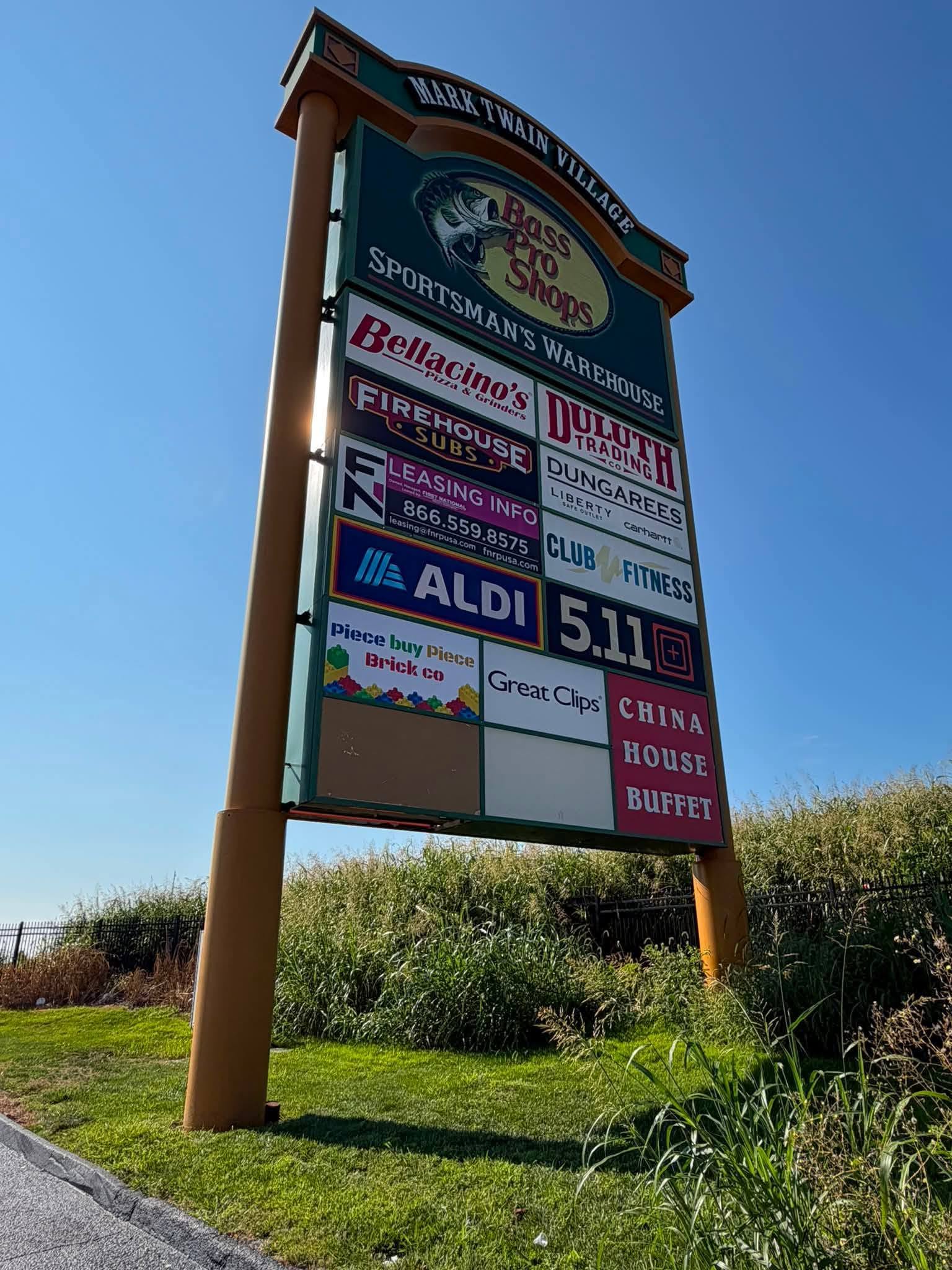
Shopping center signage has to do much more than identify a property. A successful sign system needs to help drivers recognize the shopping center from the road, give individual tenants the visibility they need, guide customers once they enter the property, and create a professional appearance across the entire development.
That makes shopping center signs in St. Peters, MO considerably different from designing a single sign for a standalone business.
A retail center may need a large roadside pylon or monument sign, individual storefront signs for every tenant, illuminated channel letters, parking and directional signs, window graphics, and a system for replacing tenant panels as businesses come and go. All of those pieces should work together instead of looking like unrelated additions made over time.
At Twin Clover Sign and Graphics, we approach signage as a complete visibility system. As a full-service sign shop, we provide custom indoor and outdoor signage and work through the process from planning and design to fabrication and professional installation. Twin Clover Sign and Graphics For shopping centers and other multi-tenant commercial properties throughout St. Peters and St. Charles County, that coordinated approach can be particularly valuable.
What Makes Shopping Center Signage Different?
A standalone business typically has one brand to communicate. A shopping center may have five, ten, twenty, or more businesses competing for attention on the same property.
The goal is not simply to make every sign as large or colorful as possible. Good shopping center signage creates a hierarchy.
The property itself needs to be recognizable. Tenants need enough visibility to help customers identify them. Drivers need to understand where to enter. Once they are inside the property, they should be able to locate the correct building or storefront without unnecessary confusion.
At the same time, individual businesses still need enough freedom for customers to recognize their brands.
That balance between consistency and individuality is one of the most important parts of designing signs for a multi-tenant retail property.
Shopping Center Signs Have to Work From a Moving Vehicle
Many customers first encounter a shopping center while driving past it. They may have only a few seconds to identify the property or recognize a tenant name.
That makes factors such as letter size, contrast, sign height, placement, surrounding landscaping, roadway orientation, and the number of tenant panels particularly important.
This is especially relevant around major commercial areas in St. Peters, including Mid Rivers Mall Drive, Mexico Road, Highway 94, Cave Springs, and other heavily traveled parts of the city.
A sign that looks impressive when viewed from ten feet away may not necessarily perform well from the road. Shopping center signage should be designed around the actual environment in which customers will see it.
Multi-Tenant Signs for Shopping Centers
Multi-tenant signs are one of the most important components of a shopping center sign system.
Rather than requiring customers to scan an entire row of storefronts from the street, a multi-tenant sign can identify several businesses from one highly visible location.
At Twin Clover Sign and Graphics, our multi-tenant signage options include monument signs, pylon signs, digital and LED configurations, and directional and wayfinding signs. These solutions can be customized around the property, its architecture, available sign area, and tenant needs. Twin Clover Sign and Graphics
A well-designed multi-tenant sign should make the information easier to understand rather than simply fitting as many business names as possible onto a structure.
Important considerations include:
- The number of tenant panels required
- Which businesses receive the most prominent positions
- Letter and logo size
- Contrast between tenant graphics and the panel background
- Overall shopping center identification
- Illumination
- Future tenant changes
- Visibility from different directions of travel
Planning these details early can make the sign significantly easier to maintain as the property changes over time.
Pylon Signs for Roadside Visibility
Pylon signs are commonly associated with shopping centers because their elevated design can make businesses visible from farther away.
This can be particularly useful when a retail center sits behind a large parking lot or when storefront signs cannot easily be seen from the main road.
A custom pylon sign may incorporate the shopping center’s name along with individual tenant panels. Depending on the property and applicable regulations, it may also incorporate illumination or electronic elements.
Height is only one part of an effective pylon sign. A tall sign filled with undersized tenant names may still be difficult to read.
Good pylon sign design considers the complete viewing experience:
- How far away drivers first see the sign
- Typical approach directions
- Road speed
- Nearby commercial signs
- Trees and landscaping
- Existing buildings
- Panel dimensions
- Logo proportions
- Daytime contrast
- Nighttime illumination
At Twin Clover Sign and Graphics, we can coordinate the design, fabrication, permitting considerations, and installation of pylon signage rather than treating each stage as an unrelated part of the project.
Monument Signs for Shopping Center Entrances
Not every retail center needs a tall pylon sign.
Monument signs provide a lower-profile option that can integrate naturally with landscaping and the architecture of a shopping center.
They can work particularly well at neighborhood retail developments, professional centers, mixed-use properties, and entrances where a substantial architectural sign is more appropriate than a tall pole structure.
A monument sign can incorporate elements such as:
- The shopping center name
- Individual tenant panels
- Dimensional lettering
- Illuminated cabinets or letters
- Stone, masonry, or architectural finishes
- Address identification
- Changeable tenant components
The structure itself can also become part of the identity of the property.
Rather than treating the sign as something placed in front of the shopping center, thoughtful monument sign design can make it look like it belongs to the development.
Storefront Signs for Individual Tenants
The roadside sign gets customers onto the property. The storefront sign helps them find the exact business they are looking for.
That distinction is important.
Every tenant needs appropriate storefront identification, but those signs should also work together visually across the building.
Storefront signs may include illuminated channel letters, dimensional letters, building signs, cabinet signs, architectural signage, or other custom solutions depending on the property and brand.
When designing storefront signs, we consider factors such as the dimensions of the available facade, visibility from parking areas, the tenant’s logo, neighboring signs, mounting location, architectural details, and nighttime visibility.
Our building sign options include illuminated channel letters, dimensional lettering, custom metal signs, architectural signage, and weather-resistant outdoor wall signs. Twin Clover Sign and Graphics
This gives property owners and individual tenants flexibility while still allowing a coordinated appearance across the shopping center.
Channel Letter Signs
Channel letters are a familiar sight on retail storefronts for good reason.
Individual dimensional letters provide strong brand recognition and can be illuminated for visibility after dark. They can work especially well for restaurants, retailers, fitness businesses, service companies, and other tenants that remain open into the evening.
For a multi-tenant shopping center, however, channel letters should not be designed in isolation.
Placement, size, mounting, illumination, and overall proportions should complement the building and neighboring signs.
St. Peters also has specific requirements affecting signage within multi-tenant shopping centers. For example, the city’s current permanent sign regulations state that channel letters are required on a building when channel letters are already the only sign style in place on that building. The code also includes requirements intended to maintain a consistent sign theme in commercial developments.
That is one reason signage requirements should be reviewed before fabrication begins.
Building and Cabinet Signs
Some shopping centers may use building-mounted signs or cabinet signs rather than individual channel letters.
Cabinet signs can provide a defined illuminated sign area containing the business name or logo, while architectural building signs and dimensional lettering can create a more integrated appearance.
The appropriate option depends on the building, existing tenant signage, landlord standards, local regulations, and the visual identity of the business.
For larger anchor tenants, the storefront may also present significantly different signage opportunities than a smaller inline retail suite.
A coordinated sign plan allows those differences while maintaining an overall relationship between the signs.
Illuminated and LED Shopping Center Signs
A shopping center does not stop needing visibility when the sun goes down.
Illuminated storefront signs, lighted tenant panels, channel letters, and properly designed freestanding signs can make businesses easier to identify during evening hours.
LED technology also gives sign designers considerable flexibility when developing illuminated signage.
The objective should not simply be maximum brightness. Effective illuminated signage maintains good contrast and readability without overwhelming the surrounding property.
Electrical access, wiring, maintenance, serviceability, and local requirements should also be considered during the planning stage.
Certain electronic or changeable-message signs may be allowed under specific circumstances in St. Peters, but those possibilities depend on the sign type, zoning, location, and applicable regulations. Property owners should confirm requirements for the individual project rather than assuming any electronic sign configuration is automatically permitted.
Directional and Wayfinding Signs
Getting customers onto a property is only the first half of the job.
Larger shopping centers can become confusing if several buildings, parking areas, entrances, drive aisles, or tenant spaces are involved.
Directional and wayfinding signage can identify:
- Shopping center entrances
- Exits
- Individual businesses
- Building locations
- Parking areas
- Pickup areas
- Drive-through lanes
- Delivery areas
- Service entrances
- Pedestrian routes
Twin Clover Sign and Graphics provides custom directional and wayfinding signage designed to make properties easier to navigate. Our broader signage offerings recognize that directional signs are intended to guide people efficiently and confidently through a space. Twin Clover Sign and Graphics
For property owners, wayfinding is sometimes treated as something to figure out after the major signs are installed. In practice, it is more effective to think about customer movement while the overall sign system is being designed.
A customer who can see a tenant from the road but cannot figure out where to turn once inside the property has only received half of the information they need.
Parking and Property Identification Signs
Parking areas introduce another layer of communication.
Depending on the shopping center, signs may be needed for accessible parking, reserved spaces, customer pickup, employee parking, loading zones, entrances, exits, and other property information.
These signs are generally more functional than a main monument or storefront sign, but consistency still matters.
Using coordinated typography, materials, colors, and placement where appropriate can make practical signs feel like part of the property rather than a collection of unrelated notices.
Regulatory signs, accessible parking signs, fire-lane requirements, and similar applications should always be handled according to the applicable local and federal requirements.
Window and Door Graphics
Storefront windows provide another useful area for branding and customer information.
Window and door graphics can communicate:
- Business hours
- Logos
- Entrance identification
- Services
- Temporary promotions
- Privacy needs
- Decorative branding
At Twin Clover Sign and Graphics, we provide options ranging from permanent branding graphics to frosted or etched vinyl and temporary promotional decals. Window graphics can be particularly useful for retail stores, restaurants, salons, fitness businesses, and other shopping center tenants. Twin Clover Sign and Graphics
The key is restraint.
When too many messages are placed in a storefront window, the result can become difficult to read. Window graphics generally work best as a supporting layer of the overall storefront rather than a substitute for clear primary signage.
Designing the Shopping Center as One Sign System
One of the biggest differences between a strong shopping center sign program and a collection of individual signs is planning.
Before designing individual pieces, it helps to understand the property as a whole.
That means considering the number of tenants, street frontage, entrances, buildings, parking configuration, traffic direction, pedestrian movement, surrounding signs, landscaping, and existing architectural features.
From there, the property can establish a clear visual hierarchy.
A typical hierarchy might include:
- Shopping center identification
- Tenant identification on the primary roadside sign
- Individual storefront identification
- Directional and wayfinding information
- Parking, regulatory, and secondary information
Each level has a different job.
If every sign tries to demand the same amount of attention, the property can become visually cluttered.
Consistency Without Making Every Tenant Look the Same
Shopping center owners often have to balance two reasonable goals.
The property should look cohesive, but tenants also need their own recognizable branding.
A good shopping center sign program does not necessarily require every tenant to use the same logo, colors, or typography. Instead, consistency may come from common placement, dimensions, materials, illumination standards, mounting methods, background treatments, or overall sign types.
The City of St. Peters specifically addresses this issue in its permanent sign regulations. Current rules state that signs within a single shopping center should maintain a consistent theme that includes color and style. The code also contains additional requirements for wall signs in multi-tenant shopping centers.
Those requirements make it particularly useful to establish sign standards before individual tenants begin ordering signage independently.
Design for Readability Before Decoration
Shopping center signs are marketing tools, but their first responsibility is communication.
A sign has to be readable before it can be impressive.
That usually means paying attention to:
- Letter size
- Contrast
- Spacing
- Viewing distance
- Logo complexity
- Number of messages
- Sign orientation
Trying to place every product, service, phone number, slogan, website, and promotional message on the same sign usually weakens the message rather than strengthening it.
For a roadside shopping center sign, the business name or recognizable logo is generally far more important than a long list of information.
Plan Around the Actual Sightline
Sign design should take the physical property into account.
A rendering can show what a proposed sign looks like by itself, but customers will not see the sign in isolation.
They will see it alongside trees, utility poles, light fixtures, parked vehicles, nearby developments, landscaping, buildings, and competing signs.
The same principle applies to storefronts. A sign may be technically visible but positioned where an architectural feature or neighboring element reduces its impact.
Planning around real-world sightlines can make a substantial difference without necessarily making the sign larger.
Build Tenant Changes Into the Sign From the Beginning
Shopping center tenants change.
That reality should influence the initial sign design.
Multi-tenant structures can often be designed with replaceable tenant panels so an individual business can be updated without rebuilding the entire sign.
For shopping center owners and property managers, it can also be helpful to maintain consistent sign specifications for future tenants.
Those standards might address:
- Permitted sign types
- Maximum dimensions
- Placement
- Materials
- Illumination
- Installation methods
- Approval requirements
- Removal when a lease ends
Twin Clover Sign and Graphics also provides directory solutions with changeable tenant panels, along with wayfinding integration, for properties where information may need to be updated over time.
Thinking about future changes at the beginning can make the property easier to manage later.
Shopping Center Sign Permits in St. Peters, MO
Local sign requirements should be part of the planning process, not something addressed after fabrication.
The City of St. Peters regulates permanent and temporary signage and provides sign information and applications through its Planning, Zoning & Development resources.
The current permanent sign regulations include specific provisions relevant to shopping centers and multi-tenant properties.
For example, when multiple tenants occupy a single building, St. Peters requires tenant signs on qualifying ground signs to be grouped on the same supports. The code also addresses additional ground signs at entrances under specific conditions and requires signs within a single shopping center to maintain a consistent theme.
Ground sign size and height can also vary according to the zoning district. The regulations establish different standards for C-2 Community Commercial, C-3 General Commercial, C-4 Regional Shopping Center, and other districts. Properties directly abutting certain major roadways may also be subject to different provisions.
For that reason, there is no single pylon or monument sign size that can be assumed to work everywhere in St. Peters.
The exact property, zoning classification, frontage, type of sign, proposed location, and current regulations need to be evaluated.
Wall Sign Requirements for Multi-Tenant Shopping Centers
St. Peters also includes provisions that specifically address wall signs in multi-tenant shopping centers.
Among other requirements, the current code addresses background colors for certain box-type wall signs, treatment of the facade behind wall signs, channel-letter requirements on buildings where channel letters are already established, and consistent sign themes within commercial developments.
These rules reinforce an important practical point: landlord sign criteria and municipal sign requirements should be considered together.
A tenant may have a strong sign concept that fits its brand perfectly but still need adjustments to work with the building or comply with the property’s established signage program.
Reviewing those issues before manufacturing can prevent unnecessary redesigns later.
New Shopping Center Signage vs. Updating an Existing Center
A new shopping center provides the opportunity to plan everything together from the beginning.
That might include:
- Property identification
- Pylon or monument signs
- Tenant panel standards
- Storefront sign guidelines
- Electrical infrastructure
- Wayfinding
- Parking signage
- Permitting
- Installation sequencing
Existing centers present a different challenge.
Often the entire sign system does not need to be replaced.
An older property may benefit from replacing faded tenant panels, modernizing the main monument sign, repairing illumination, updating storefront signs, adding better wayfinding, or creating a more consistent appearance across signs installed at different times.
Twin Clover Sign and Graphics provides maintenance, updates, and sign repair in addition to new signage, which allows us to evaluate whether an existing component can reasonably be refreshed rather than automatically recommending complete replacement. Twin Clover Sign and Graphics
That can be particularly useful for established shopping centers working through improvements in phases.
Choosing Materials for Long-Term Outdoor Use
Shopping center signs remain outside through Missouri summers, winters, rain, wind, sun, and daily exposure.
Material selection matters.
Depending on the sign, construction may incorporate exterior-rated metals, acrylic or polycarbonate faces, dimensional components, LEDs, durable finishes, structural supports, vinyl graphics, and other materials selected for the application.
Maintenance access should also be considered.
An illuminated sign that is difficult to service can become inconvenient later. Likewise, a multi-tenant sign that requires extensive disassembly every time a business changes can create unnecessary expense.
Our approach at Twin Clover Sign and Graphics emphasizes custom design, quality materials, and detail-oriented craftsmanship rather than treating every property as if it needs the same standard sign. Twin Clover Sign and Graphics
Why Professional Sign Installation Matters
Even a well-designed and well-fabricated sign depends on proper installation.
Exterior shopping center signage may involve structural mounting, electrical components, elevation, heavy sign cabinets, freestanding structures, or installation around active parking lots and businesses.
Alignment and positioning also affect how a finished sign looks.
Our sign installation services include storefront and building signs, channel letters and illuminated signs, monument and pylon signs, directional and wayfinding signs, and other commercial signage throughout St. Charles County. Twin Clover Sign and Graphics
For larger shopping center projects, coordinating design, fabrication, and installation through the same overall process can also reduce the possibility of one stage being designed without considering the requirements of the next.
Common Shopping Center Sign Mistakes
Many signage problems begin long before fabrication.
One common mistake is trying to place too much information on a roadside sign. Adding another tenant may feel useful, but if every panel becomes too small to read from traffic, the sign has lost much of its purpose.
Another is designing signs without studying the actual property. Landscaping, roadway approach, building orientation, and parking configuration can significantly affect visibility.
Allowing every tenant to independently choose a completely different sign format can also result in a disorganized appearance and may conflict with landlord standards or municipal requirements.
Other common issues include failing to plan for future tenant changes, overlooking nighttime visibility, waiting too long to investigate permitting, and treating directional signs as an afterthought.
A coordinated plan can address these issues before they become expensive changes.
What a Complete Shopping Center Sign Project Looks Like
At Twin Clover Sign and Graphics, our overall sign process includes consultation, planning and design, skilled fabrication, expert installation, and attention to the completed result. Twin Clover Sign and Graphics
For a shopping center, that process can begin with understanding the site itself.
Consultation and Site Evaluation
We first need to understand the property, existing signs, tenant requirements, visibility concerns, entrances, traffic flow, and the objectives of the owner or property manager.
Planning and Design
From there, the sign system can be developed around the property’s identity, tenant organization, available space, materials, illumination, local requirements, and architecture.
Permitting and Project Coordination
Depending on the project, sign applications, landlord approvals, engineering, electrical coordination, or other project requirements may need to be addressed before fabrication.
Fabrication
Once the concept and project requirements are established, the approved signage can be produced using materials and fabrication methods appropriate for the application.
Installation
Professional installation puts the design into its real environment, with attention to positioning, mounting, alignment, electrical components where applicable, and disruption to businesses operating on the property.
Maintenance and Future Updates
Shopping centers continue to evolve after installation. Tenant panels may need replacement, lighting may eventually require service, and individual storefronts may change.
Designing the system with those changes in mind can make future updates significantly easier.
Choosing a Shopping Center Sign Company in St. Peters
For a multi-tenant property, it can be helpful to work with a sign company capable of handling more than one particular product.
A complete shopping center project may require pylon signs, monument signs, tenant panels, channel letters, building signs, directional signage, window graphics, fabrication, permitting coordination, installation, maintenance, and future updates.
That is why we provide full-service signage solutions at Twin Clover Sign and Graphics rather than limiting our work to a single category of signs.
We are locally owned and family-run, and our focus is on custom signage created around the individual property and business. Our website describes the company as a full-service sign shop and emphasizes collaboration, quality signage, custom design, durable materials, and individualized customer service. Twin Clover Sign and Graphics
For shopping center owners and property managers, having one team capable of working across the property can make it easier to maintain consistency from the roadside sign all the way to the storefront.
Shopping Center Signage Throughout St. Peters and St. Charles County
While this guide focuses specifically on shopping center signs in St. Peters, the same planning principles apply throughout St. Charles County.
Twin Clover Sign and Graphics works with businesses and commercial properties throughout areas including St. Peters, St. Charles, O’Fallon, Lake St. Louis, Wentzville, and surrounding communities.
For property owners managing multiple locations, establishing consistent signage standards can also help create a recognizable approach across several shopping centers or commercial developments.
Frequently Asked Questions About Shopping Center Signs in St. Peters, MO
What types of signs does a shopping center typically need?
The exact combination varies by property, but common shopping center signs include pylon or monument signs, multi-tenant panels, individual storefront signs, channel letters, building signs, directional signs, parking signs, entrance and exit signs, window graphics, and other property identification.
What is the difference between a pylon sign and a monument sign?
A pylon sign is generally elevated to provide greater visibility from a distance, while a monument sign has a lower profile and often incorporates architectural or masonry-style elements. The right option depends on the property, road visibility, desired appearance, zoning, and local sign requirements.
Can every shopping center tenant use its own logo and colors?
Individual tenant branding can often be incorporated, but it may be subject to landlord sign criteria and municipal regulations. St. Peters has specific consistency requirements for signs within shopping centers and commercial developments, so each proposed sign should be evaluated in context.
Do shopping center signs require permits in St. Peters?
Many permanent signs are regulated by the City of St. Peters. The city provides sign information and applications through its Planning, Zoning & Development department, and requirements vary according to sign type, zoning, dimensions, location, and other factors.
Can an existing shopping center sign be updated instead of replaced?
Often, yes. Depending on its condition and construction, an existing sign may be a candidate for new tenant panels, updated graphics, repaired lighting, replacement faces, structural improvements, or other maintenance. The existing sign should be evaluated before deciding whether updating or replacement makes more sense.
Can shopping center signs be illuminated?
Many types of commercial signs can incorporate illumination, but the exact design needs to comply with the regulations applicable to the property. Channel letters, illuminated sign cabinets, pylon signs, and monument signs are among the possibilities.
How should shopping centers prepare for tenant turnover?
Where appropriate, use replaceable tenant panels and establish clear sign specifications for new businesses. Keeping original artwork, dimensions, material specifications, and sign standards can also make future updates easier.
Create a Shopping Center Sign System That Works From the Road to the Storefront
Good shopping center signage should create a simple progression.
A customer notices the property from the road. They recognize the shopping center or the tenant they are looking for. They know where to enter. Directional signs help them move through the property. Finally, the storefront signage confirms they have reached the right business.
When those elements are planned together, signage becomes more than decoration. It becomes part of how the property works.
At Twin Clover Sign and Graphics, we provide custom multi-tenant signs, pylon and monument signs, storefront and building signs, channel letters, illuminated signage, directional and wayfinding signs, window graphics, professional installation, and ongoing sign services for commercial properties throughout St. Peters and St. Charles County.
Whether you are developing a new shopping center, updating an older property, replacing tenant panels, or trying to create a more consistent sign system across an existing retail center, we can help evaluate the property and develop signage around its actual needs.
To discuss a shopping center signage project in St. Peters, you can contact Twin Clover Sign and Graphics and tell us about the property, the signs you are considering, and what you would like to improve.
Back