Battlehawks Kick Off 2026 Season with Win in Front of 31,000+ Fans
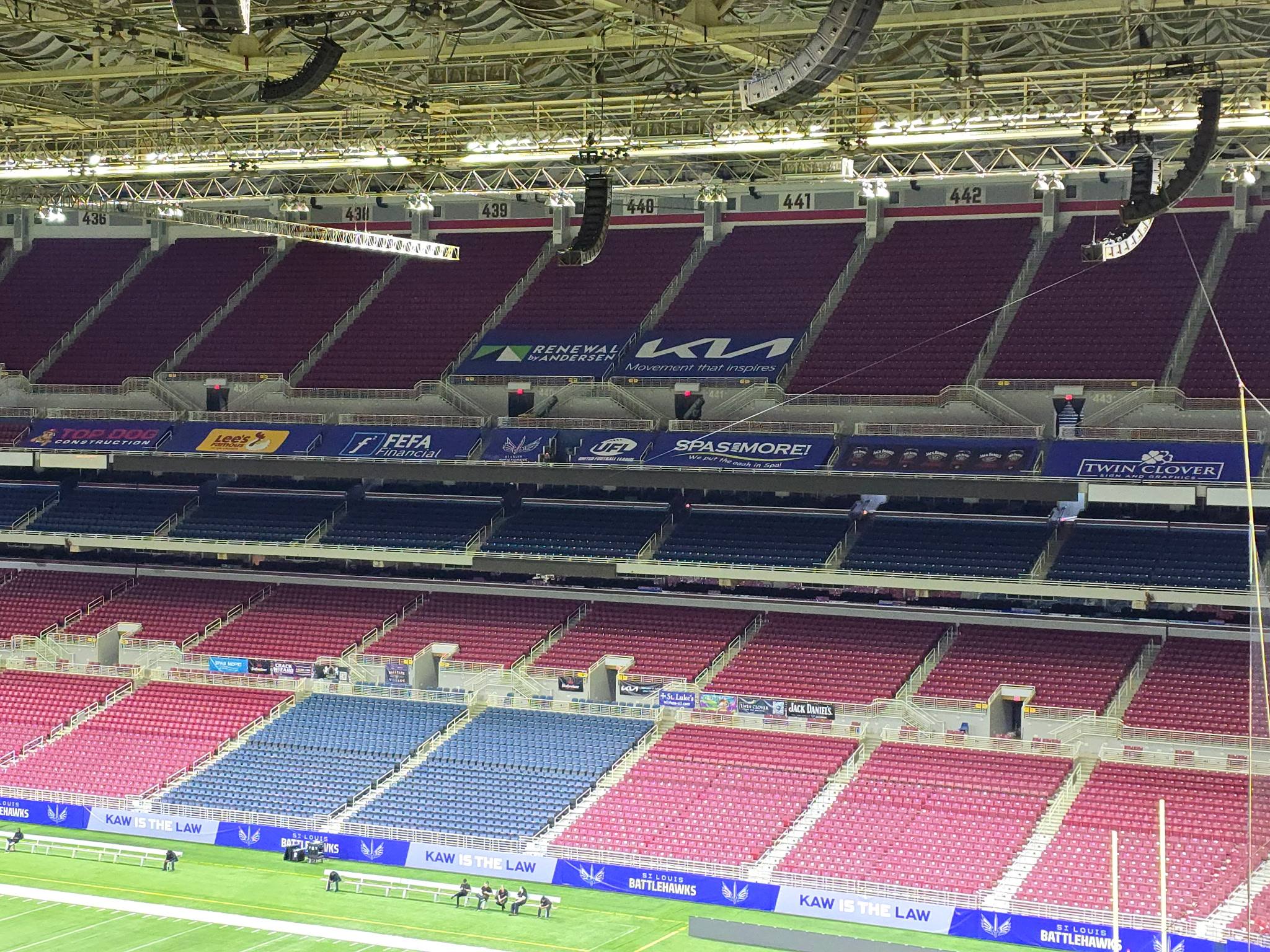
The Battlehawks opened the 2026 season with a 16–10 win over the DC Defenders at The Dome at America’s Center, a game that immediately felt like a statement about what spring football looks like in St. Louis.
From a pure football perspective, the early headline was defense. The Battlehawks’ defensive front created consistent pressure, finishing with seven sacks and two interceptions, holding DC scoreless after halftime.
From the city perspective, the headline was the crowd. Coverage of opening weekend reported 31,191 in attendance for the St. Louis opener, a number that stood out league-wide and reinforced the Battlehawks’ reputation as one of spring football’s strongest draws.
This game also marked the head coaching debut of Ricky Proehl, and the matchup and kickoff-week framing were promoted league-wide in the lead-up to March 28.
For our team at Twin Clover Sign and Graphics, it was the kind of moment where you feel the scale of the environment. A packed stadium changes everything: sound, movement, pacing, lines, entrances, and how people experience the space.
If you want the background on our official partnership with the Battlehawks, we keep that story and updates here: https://twincloversign.com/battlehawks
The full stadium experience and what people noticed beyond the field
Before kickoff, the league framed the day as part of “Spirit of St. Louis” Kickoff Weekend, meant to celebrate the city’s culture, history, and fandom. It was promoted alongside a stadium-wide “Blue Out” concept and fan giveaways, all designed to make the home opener feel bigger than a normal Week 1 game.
At halftime, Nelly and St. Lunatics were the featured performers, a detail the league announced ahead of time as part of the home opener experience.
But for anyone who has ever been inside a venue like The Dome, the “game day experience” is also built by the environment itself. People are constantly processing information:
- Where do I enter?
- Where am I sitting?
- Where are concessions and restrooms?
- How do I get back to my section quickly?
- What’s the best route if I’m meeting friends?
That is where signage becomes part of the story, even if most fans never stop to think about it directly.
In a post that our team shared after the game, we called out the variety of physical branding and wayfinding that fans encountered: large-scale advertising banners, branded field signage, new concourse signs, and custom-branded entrance doors. We also shared a fun detail about the frequency of our logo placement inside the venue, noting that it appeared at least 48 times throughout the Dome, not even counting digital placements or commercials.
That mix matters because it reflects how high-traffic environments actually work. On big event days, clarity reduces friction. Consistent visuals make the space feel organized. Strong branding creates a unified atmosphere. Directional decisions become easier when the environment is designed to guide people instead of forcing them to guess.
If you want to see more partnership context and updates as the season continues, that hub is here: https://twincloversign.com/battlehawks
What game day signage teaches businesses about visibility
It is easy to talk about “visibility” as a marketing buzzword. A stadium opener like this makes it tangible.
When 31,000 people show up, attention becomes a scarce resource. People are moving, talking, scanning, and making rapid decisions. You cannot rely on someone slowing down to interpret something confusing. You have to communicate quickly and cleanly.
That principle is not exclusive to sports. It is the same reality for businesses across the St. Louis metro.
If a customer is driving past your location, scrolling a map, or navigating a busy commercial corridor, you often have seconds to do three jobs at once:
- Confirm what your business is
- Show that you look credible and established
- Make the next step obvious (enter here, park here, call this number, follow this arrow)
That is why so many of the “unsexy” sign categories become the most important ones over time. Directional and wayfinding signs reduce confusion. Entry signage removes hesitation. Clear building identification prevents missed turns. In an environment where people are already busy, clarity wins.
This is also where consistency starts to matter more than most businesses expect. In a stadium, the experience feels “right” when everything looks like it belongs together: entrance doors, concourse, field-level, sponsor placements, and navigational signs.
Businesses experience the same effect. When your exterior sign, your front-door lettering, your lobby signage, and your internal wayfinding all feel cohesive, customers interpret that as professionalism. When those elements clash or look improvised, it subtly reduces confidence.
The best part is that you do not need a stadium to apply stadium-level thinking. You just need a plan.
High-impact signage services that translate from stadiums to storefronts
At Twin Clover Sign and Graphics, we focus on custom, high-quality signage built for real-world conditions, and our website reflects how wide the signage “ecosystem” can be, from exterior visibility to interior guidance to portable event displays.
Below are practical, business-friendly ways to translate what we all saw at The Dome into everyday projects that help local organizations get seen.
Outdoor visibility that earns attention A stadium uses large-format elements because scale and distance demand it. Businesses have similar needs, just on a smaller stage.
Common high-impact options include building signs, cabinet signs, channel letters, monument and pylon signs, and projecting blade signs.
Blade signs are a great example of “stadium thinking” in a walkable district. They extend out from the building, helping you get noticed from multiple angles, not just straight-on. Our blade sign page breaks down how projecting placement improves visibility from both directions along a street or walkway, which is exactly the kind of sightline planning big venues use.
Interior signage and wayfinding that keeps people moving Stadium concourses are basically wayfinding stress tests. If the system is unclear, people stack up, stall out, and get frustrated.
For businesses, the same concept applies to:
- corporate lobby and office signs
- directories and informational signs
- menu boards
- bathroom signage
- wayfinding systems across multi-room facilities
If you operate a healthcare facility, a school, or any public-facing building, ADA signage is a major part of that clarity. Our ADA signs page highlights tactile lettering, braille, and high-contrast design, and describes ADA signs as both an accessibility requirement and a customer experience element.
Vehicle wraps and fleet graphics as mobile visibility Stadiums use repeated branding across multiple touchpoints because frequency builds memory.
For a local business, fleet graphics and vehicle wraps can create that same repetition across the region, turning everyday driving into consistent exposure. Our product navigation includes fleet graphics, truck and van wraps, and vehicle graphics as core offerings.
Trade show and event graphics The “opening weekend” approach in St. Louis was essentially an event marketing play: create a moment, make it cohesive, make it memorable.
For businesses, trade show displays and banners do similar work. Our product navigation includes trade show graphics and trade show banners, plus options like pull-up banners and event signage, which can be especially useful for community events, recruiting fairs, school functions, and seasonal promotions.
How we approach projects (so the result feels intentional, not pieced together) Across our published content, we describe a full-service approach that runs from early planning and design through fabrication and installation. In our blog content, we also describe a repeatable process: consultation and goal-setting, planning and design, fabrication, installation, and follow-up.
That is the part that often separates “a sign” from “a visibility system.” When projects are planned as a system, businesses typically get better results because signage stops being random and starts being strategic.
If you want to start a conversation about an upcoming signage project, our contact page is here: https://twincloversign.com/contact/
Closing thoughts and local contact information
The Battlehawks’ 2026 opener was a reminder of what St. Louis looks like when it gets behind something: a major crowd, a strong atmosphere, and a full-scale game day experience where every detail matters, including the environment people move through.
For Twin Clover Sign and Graphics, being part of that environment is meaningful, and it also connects directly to what we do for local organizations every week. Whether your “high-traffic day” is a Saturday crowd, a Monday morning rush, or a constant stream of customers who are new to your building, the goal is the same: make it easy to find you, easy to trust you, and easy to take the next step.
To follow along with our Battlehawks partnership and related updates, visit: https://twincloversign.com/battlehawks
To talk with our team about a sign, wrap, wayfinding system, or a full refresh that helps your business stand out, contact us here: https://twincloversign.com/contact/
Back